
The CIRPs featured below are exploring innovative approaches to improving learning outcomes and supporting the fullness of life for all. While each prototype focuses on a distinct area of inquiry, together they are fostering a culture of collaboration, innovation and continuous improvement across the Diocese.
This prototype is about bringing Religious Education Leaders from local schools together to reimagine sacramental formation in the Star of the Sea South West Coast Parish. Through shared planning, family formation sessions and student formation days, the prototype is strengthening school, parish and family connections while building leadership confidence and a shared approach to Catholic identity and formation.
Lead school: St Joseph's Primary School, Warrnambool
CEB contact: Jo-anne Van der Voort
Participating schools:
- Our Lady Help of Christians Primary School, Warrnambool,
- St Pius X Primary School, Warrnambool,
- St John's Primary School, Dennington,
- St Patrick's Primary School, Port Fairy,
- St Patrick's Primary School, Koroit
Podcast Episode: Season 2 Episode 6 - CIRP Spotlight: Star of the Sea Parish Sacramental Reimagining Prototype
This project is exploring outstanding examples of schools where student engagement, agency and a genuine joy for learning are thriving. Through collaborative field trips and ongoing inquiry, participants are investigating how schools effectively balance explicit instruction with opportunities for student-led learning. As part of this research, four field trips are being conducted, enabling different staff groups to visit Kunyung Primary School in Mt Eliza to observe these practices in action and gather insights to inform their own contexts.
Lead school: St Mary's Primary School, Swan Hill
CEB contact: Chris Mitchell & Samantha Meerbach
Participating school:
- St Mary’s Primary School, Sea Lake
This project is about connecting rural and regional schools through shared professional learning in evidence-based literacy practice. By creating a local training hub and bringing teachers and learning support officers together, the prototype is strengthening instructional consistency, building staff confidence and improving access to high-quality professional learning without schools needing to work in isolation.
Lead school: Siena Catholic Primary School, Lucas
CEB contact: Julie Cooper & Belinda Chiswell
Participating schools:
- St Patrick's Primary School, St Arnaud
- Lumen Christi Primary School, Delacombe
- St Malachy’s Edenhope
- St Joseph’s Primary School, Coleraine
Podcast Episode: Season 2 Episode 8 - Collaborative Literacy Network: Sounds Write Training
This project is exploring how explicit, research-informed teaching about responsible digital citizenship can support students to navigate online environments safely, respectfully and confidently. Bringing together students from three connected primary schools, the project investigates how building knowledge, skills and positive digital behaviours can strengthen relationships, foster a sense of belonging, and support a successful transition into secondary school. Through shared learning experiences and evidence-based practices, the project aims to empower students to form positive connections and engage responsibly in an increasingly digital world.
Lead school: St Colman's Primary School, Mortlake
CEB contact: Anne Ruddell
Participating schools:
- St Patrick's Primary School, Camperdown
- St Thomas' Primary School, Terang
This project is exploring how schools can create more inclusive and strategic pathways for staff leadership. By offering supported leadership experiences, mentorship, practical workshops and opportunities to engage with the DOBCEL Leadership Competency Framework, the prototype is helping staff build confidence, develop capability and see leadership as something that can be nurtured across a whole school community.
Lead school: St Alipius Parish School
CEB contact: Jo-Anne Bond & Fiona Murphy
Participating schools:
- St Brigid’s Primary School, Ballan
- St Aloysius’ Primary School, Redan
Podcast Episode: Season 2 Episode 7 - Nurturing Leadership from Within
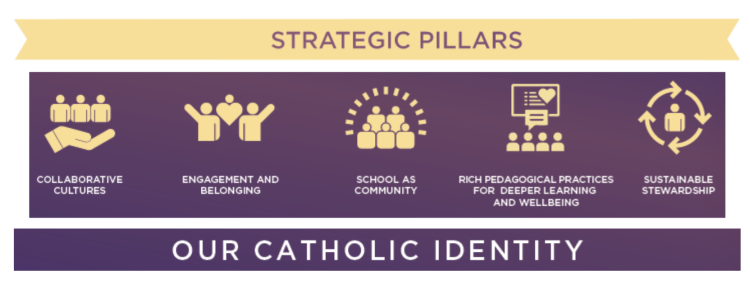
The project is a practical embodiment of Pillar 4 Rich Pedagogical Practice for Deeper Learning & Wellbeing. It aims to nurture a culture of collaboration, build pedagogical depth and ensure that teacher knowledge and confidence supports learning pathways in Mathematics. The focus on capacity, consistency and evidence-based practice lays the groundwork for deeper learning and impact at a system level. The project also recognises the importance of building capability in staff to develop teaching repertoires that support high levels of learning for students.
Lead school: St Joseph's Primary School, Red Cliffs
CEB contact: Sam Meerbach & Joe Ewing
Participating schools:
- Sacred Heart Primary School, Mildura
- St Coleman’s Primary School, Mortlake
This project is bringing together St Patrick’s Primary School, Ballarat, St Thomas More, Alfredton, Siena Catholic Primary School, Lucas, and St Columba’s Primary School, Ballarat East, to explore a more coherent and systematic approach to leadership and professional learning across the cluster. Inspired by the Catholic call to community, service and continual formation, the prototype is focused on strengthening trust, shared purpose and accountability so schools can benefit from each other’s innovation and expertise.
Lead school: St Patrick’s Primary School, Ballarat
CEB contact: Matt Byrne
Participating schools:
- St Thomas More Primary School, Alfredton
- Siena Catholic Primary School, Lucas
- St Columba's Primary School, Ballarat East
Our schools have identified a significant proportion of students who are not demonstrating the expected level of academic growth from one year to the next, as evidenced by Progressive Achievement Test (PAT) data and corroborated by NAPLAN results. In addition, Insight SRC survey data indicates a decline in overall student engagement, further reinforcing the need for targeted intervention and improvement strategies.
Lead school: St Pius X Primary School, Warrnambool
CEB contact: Teresa Hadden
Participating schools:
- St Joseph’s Primary School, Warrnambool
- All Saints Primary School, Portland
- St John’s Primary School, Dennington
Behaviour data across the three schools shows a high proportion of neurodiverse students involved in incidents. Teacher confidence and use of autism-informed practices vary, with limited evidence-based strategies in classrooms. Professional learning and family-school communication are inconsistent, and current approaches are largely reactive. The findings highlight a need for collaborative professional learning, shared strategies, and proactive practices to improve engagement and wellbeing.
Lead school: Our Lady Help of Christians Primary School, Wendouree
CEB contact: N/A
Participating schools:
- St James' Parish School, Sebastopol
- St Michael’s Primary School, Daylesford
- St Mary’s Primary School, Clarkes Hill
This project is supporting students to use Science, Technology, Engineering and Mathematics to Make a Difference in the world, with a focus on justice, the common good and care for creation. Through collaboration between Emmaus and St Columba’s Year 5 and 6 students, the prototype will culminate in a STEM MAD showcase at Damascus College this coming August, where students will share their projects with other schools and the wider community.
Lead school: Emmaus Catholic Primary School, Mt Clear
CEB contact: Coby Reynolds, Joe Ewing
Participating schools:
- St Columba’s Primary School, Ballarat North
Podcast Eppisode: Season 3 Episode 4 - STEM MAD Collaboration in Action
Findings will be shared back to the DOBCEL community. A Catholic Education Ballarat (CEB) staff member may partner with schools to assist with the CIRP initiative.
Funding support requests up to $30,000 will be considered. Principals are to submit CIRP applications via the simanager@dobcel.catholic.edu.au email to indicate their endorsement.
In 2026, applications will be accepted only in Week 5 of Term 3. They will then go to the CIRP panel for review and the outcome will be communicated by Week 9 of Term 3.
Please watch the video explainer below for more information about the Collaborative Innovation Research Prototype (CIRP) initiative.
For further assistance with this application process, please contact Julia Petrov, Strategy Implementation Manager at simanager@dobcel.catholic.edu.au.
Section 1: Prototype | |
|---|---|
| Prototype Title (up to 7 words) | Consider a name for your prototype, noting that this is how it will be referred to moving forward. Your title should capture the main essence of your prototype. |
| Strategic Pillar Alignment |
|
| Briefly explain how this prototype advances the aims of the chosen Strategic Pillar(s) of Strategy 2035. | |
Section 2: Applicant Details | |
|---|---|
| Lead School | |
| Lead Contact Name | |
| Role/Position | |
| Phone Number | |
| Collaborating School/s & Contact Name/s | |
| Catholic Education Ballarat Contact Name (if relevant) | |
| Additional Organisation & Contact Name (if relevant) | |

Section 3: Prototype Rationale | |
|---|---|
| Step 1 - Understanding the Challenge | |
| Context | Briefly outline educational setting, e.g., environment, resources, cultural background, and community (dot points). |
| Educational challenge | Briefly describe the challenge your prototype will address, including any relevant evidence (e.g. observations or data) that shows why this issue is important. |
| Inquiry Question | What is the main question or idea you want to explore through this prototype? |
| Implementation Activities (How) | How will it be done? Note key activities. We understand your plan may evolve as you try, test, and adapt your prototype – just give your best initial outline. (dot points) |
| Theory of Change | Note how the Practical Principles will be utilised:
|
| Research Basis | List the research evidence relating to your educational problem. Possible sources:
This is a starting point – you may well do more research as your prototype progresses. |
| Measuring Impact | What data will you collect (multiple sources) to address your research question? Some of this data will be same as that used as baseline data so that it can be compared to see how it changes overtime. Also note any new data you plan to collect. Possible sources:
|
| Understanding Impact | Outline the process for data analysis (dot points: who & when). |
| Expected Outcomes | Outline the anticipated results for the implementation activities (dot points – up to four). |
Section 4: Collaboration and Partnerships | |
|---|---|
| Prototype Team | List the key school staff who will be involved in this prototype. |
| Role of Catholic Education Ballarat (CEB) Representative | If relevant – briefly note how a CEB staff member will be involved in your prototype. |
| Collaborating Organisations / Experts | If relevant, note how other parties will be engaged in your prototype. |
| Collaboration plan | How will the collaborating schools work together to prototype and learn? (e.g. joint planning sessions, co-teaching, sharing results). Consider how you will build trust and a safe, collaborative environment within your team. |
Section 5: Budget – Resources and Funding Request | |
|---|---|
| Staff Release | List requirements and associated costs. |
| Facilitation / Presenters / Experts | List requirements and associated costs. |
| Equipment | List requirements and associated costs. |
| Venue / Catering | List requirements and associated costs. |
| Travel | List requirements and associated costs. |
| Other | List requirements and associated costs. |
| CIRP Total Budget Requested (up to $30,000 per year) | List total amount requested. |
Section 6: Communication of Learnings | |
|---|---|
| Learning capture | Nominate a person who will coordinate your prototype Check-In and Update learning along the way. |
| Audiences & mediums | Consider simple strategies (annotated meeting notes, newsletter article, podcast, short videos, or a one-page summary) to share prototype findings across the school community and beyond. |
| System Connection | In what ways might this prototype’s learnings be relevant to other schools or to the wider system? |
Section 7: Timeline | |
|---|---|
| Action Timeline | Using dot points, outline actions in a timeline. |
| Proposed Start Date & End Date (approx. 12 months) | |
Section 8: Submission Checklist | |
|---|---|
| Submission Instructions | Proposals for 2026 are to be submitted via email from a principal to indicate principal endorsement. Please email the Strategy Implementation Manager at simanager@dobcel.catholic.edu.au by Friday Week 5 of Term 3. |
CIRP Frequently Asked Questions (FAQs)
Applications are reviewed by a panel using a structured scoring rubric. The selection rubric aligns with key elements of a Collaborative Innovation Research Prototype (CIRP) and considers:
- The strength of the collaborative partnership
- The quality of the inquiry and proposed innovation
- Alignment with DOBCEL strategic priorities
- Potential impact and learning for the wider system
- Feasibility of the proposed approach
- Prior CIRP involvement
- Budget justification
Yes. When you partner with one or more primary schools as part of the collaborative project.
The intention is to encourage cross-school collaboration and shared learning. Please note CIRP funding does not cover secondary staff release time.
Collaboration in a CIRP must be between two or more primary schools. This involves schools working together on a shared inquiry, contributing to collective learning, and sharing insights and outcomes that can inform practice beyond a single school.
Innovation does not necessarily mean creating something entirely new. Within a CIRP, innovation refers to exploring, testing or adapting approaches that have the potential to improve outcomes for learners, educators or school communities.
Innovative inquiries typically:
- Address a genuine challenge, opportunity or area for improvement
- Draw on evidence, research and professional expertise
- Test a new approach, adaptation or application within a local context
- Generate learning that can inform practice beyond the participating schools
A strong CIRP focuses not only on implementing an idea, but also on learning from the process and sharing those insights with the wider DOBCEL community.
Strong applications typically:
- Demonstrate meaningful collaboration between schools
- Clearly define the problem, opportunity or inquiry focus
- Show alignment with DOBCEL strategic priorities
- Include a realistic timeline and budget
- Note how learning will be captured and shared
- Identify the potential value for participating schools and the broader DOBCEL system
Yes. Schools may participate in more than one CIRP. However, consideration should be given to how a CIRP relates to their Annual Action Plan and a school’s capacity to release staff to be involved in more than one CIRP. Applications should clearly demonstrate the value of the proposed inquiry, the strength of the collaboration, and the potential contribution to system learning.
CIRPs are intended to generate learning for all participating schools and the wider DOBCEL community. Schools are expected to engage in in learning check-ins throughout the project as well as sharing key insights, findings and reflections through a series of activities at the conclusion of the CIRP.
Yes. Schools may apply for renewal where further inquiry, testing, implementation or learning is required. Renewal applications are considered on their merits and should demonstrate the value of continuing the work and the potential for further learning and impact.
Schools are encouraged to identify partners through existing networks, professional relationships and shared areas of interest. DOBCEL may also provide opportunities to connect schools with similar inquiry interests to support the development of collaborative proposals.
A CIRP is more than the implementation of a program or initiative. It involves a collaborative inquiry between schools, testing or adapting an innovative approach, and generating learning that can be shared with and benefit the wider DOBCEL community.
CIRP funding may be used for costs that directly support the inquiry, collaboration, implementation and learning activities associated with the project. This may include staff release, facilitation, professional learning, resources, travel, catering and other justified project expenses. Budgets should be realistic, clearly itemised and aligned to the goals of the CIRP.
Here are some numbers to assist with calculations
| Travel | $0.91 per km |
| Catering | $25 per person |
| Staff Release | $505 per day |
Below is an example of how you may itemise expenses.
Example CIRP Budget
| Category | Description | Cost |
| Staff Release | Initial planning meeting (4 middle leaders x 1 day @ $505) | $2,020 |
| Collaborative planning days (4 middle leaders x 2 days @ $505) | $4,040 | |
| Professional learning day (4 middle leaders x 1 day @ $505) | $2,020 | |
| Final planning and evaluation day (4 middle leaders x 1 day @ $505) | $2,020 | |
| Subtotal | $10,100 | |
| Facilitation / Presenters / Experts | Professional learning facilitator (Day 1) | $2,000 |
| Professional learning facilitator (Day 2) | $1,500 | |
| Subtotal | $3,500 | |
| Resources / Equipment | Professional learning books (4 x $40) | $160 |
| Subtotal | $160 | |
| Venue / Catering | Catering for planning days (5 x 25=125) 2 days | $250 |
| Catering for remaining days (4 x 25 = 100) 3 days | $300 | |
| Venue hire (2 days @ $250) | $550 | |
| Subtotal | $1,100 | |
| Travel | 91 cents per km 4 Staff travelling 50km for 2 planning days (4 x 0.91= 45.5) 2 days = $91 | $91 |
| 4 staff travelling 210kms in total for remaining days =210 x .91 = $191.1 | $191.10 | |
| Guest presenter accommodation | $400 | |
| Subtotal | $682.10 | |
| Other | Printing and engagement materials for parent/community event | $500 |
| Subtotal | $500 | |
| Total Budget Requested | $16,042.10 |
Please note: This example is provided for illustrative purposes only. Actual budgets will vary depending on the scope, scale and requirements of each CIRP. All costs should be clearly justified and directly linked to the proposed inquiry, implementation activities and anticipated outcomes.